출처 : https://www.aitimes.com/news/articleView.html?idxno=208877
젠슨 황 "마벨 3조 투자의 핵심은 미래 먹거리 'AI-RAN' 구축" - AI타임스
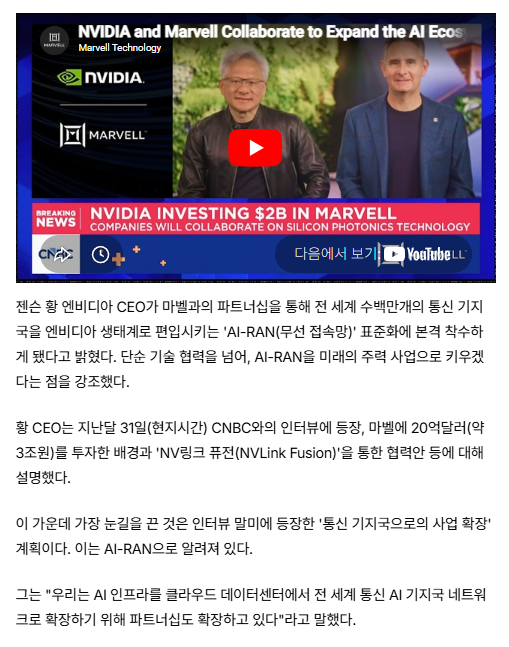
젠슨 황 엔비디아 CEO가 마벨과의 파트너십을 통해 전 세계 수백만개의 통신 기지국을 엔비디아 생태계로 편입시키는 'AI-RAN(무선 접속망)' 표준화에 본격 착
www.aitimes.com

AI-RAN에 관한 젠슨 황의 언급 이후로 RAN 관련 회사의 주가가 실제로 올랐다고 한다.
젠슨 황은 AI-RAN에 대해 2026 3월부터 계속 언급해왔는데, AI 엣지 서버를 통해, 한 곳에서 관리하겠다는 의미다.
현재는 각국의 통신사에서 기지국을 설치하고 서비스를 제공한다면, GPU를 통한 AI 서버를 통해 서비스하겠다는 의미같다.
특히나, 주목할 기술은 Edge AI로 보고, 그 전에는 클라우드를 거치며, 데이터를 가져오거나 AI를 불러올 수 있었다. 이유로는 데이터를 기지국에서 관리하기에는 자원이 부족하고 AI 연산을 하기에도 기술이 부족했기에, 클라우드에 데이터를 저장해야만 했다. 하지만 GPU 및 서버 기술이 발전하므로써 이를 PHY 단에서 가능할 것이고 이를 추진하겠다는 것으로 보인다.
Edge AI 기술로 MEC의 개념을 설립시킨다면, 지연시간을 소폭 줄이면서도 기지국 바로 옆 서버에서 연산 및 추론을 할 수 있게 된다.
특히나, 이동통신은 ms~s 단위로 결정되고, RAN의 경우는 ms 단위로 결정되기에, 지연시간은 매우 중요한 요소인데, 이를 RAN에서도 소형 서버를 둠으로써 동시에 추론과 RAN 역할(스케줄링, 빔포밍, 자원할당 등)을 할 수 있다는 것은 매우 혁신적으로 보인다.
저번 젠슨 황이 AI-RAN을 위한 GPU가 탑재된 네모트론 모델을 오픈소스로 공개했다고 하는데, 이를 학습하기 위해서는 통신사의 데이터가 중요할 것으로 생각되나, 각 국의 통신사에서 절대로 이를 공개할리 없다고 생각한다.
개인적으로는 이 기술이 정말 실현된다면, 우리나라 통신사에도 기존에 없었던 큰 변화가 생기지 않을까 싶다.
AI-RAN을 연구하는 입장에서 Core에서는 실현하기 어렵지 않을 것 같은데, 논문에서 연구하던 것을 실제 RAN에서도 실현된다면 엔비디아 기준으로 여러 기업들의 기술에 놀라울 것 같다.
Since Jensen Huang began emphasizing AI-RAN in early 2026, the stock prices of several RAN-related companies have reportedly increased. He has repeatedly highlighted AI-RAN as a key future technology, suggesting a vision in which AI edge servers manage both AI workloads and radio access network (RAN) functions within a unified infrastructure.
Traditionally, mobile operators deploy and operate base stations to provide communication services. However, the AI-RAN concept appears to extend this model by leveraging GPU-based computing platforms capable of supporting both AI processing and RAN operations. In other words, communication and AI services can coexist on the same computing infrastructure.
One of the most promising technologies in this context is Edge AI. Previously, AI services typically relied on cloud data centers because base stations lacked sufficient computational resources and AI acceleration capabilities. As a result, data had to be transferred to the cloud for storage, processing, and inference. With the rapid advancement of GPU and server technologies, however, it is becoming increasingly feasible to perform these tasks much closer to the network edge, potentially even at the physical-layer infrastructure level.
By integrating Edge AI with the concept of Multi-access Edge Computing (MEC), inference and data processing can be executed on servers located directly adjacent to base stations. This reduces dependence on remote cloud resources and can significantly lower end-to-end latency.
Latency is particularly critical in mobile communication systems. Many RAN functions, such as scheduling, beamforming, and radio resource allocation, operate on millisecond-level timescales. Therefore, the ability to deploy compact AI servers alongside base stations and simultaneously perform AI inference and RAN operations represents a potentially transformative development for future wireless networks.
Jensen Huang recently announced an open-source AI-RAN-oriented Nemotron model equipped for GPU-based deployment. However, I believe that access to real telecom data will be crucial for training and optimizing such models. Since operators are generally reluctant to publicly release their network data, obtaining high-quality training datasets may remain one of the major challenges for AI-RAN research.
Personally, if this technology is fully realized, it could bring unprecedented changes to the Korean telecommunications industry. From a researcher's perspective, implementing AI-driven intelligence in the core network does not seem particularly difficult. However, seeing concepts that have largely remained within academic papers become practical realities in commercial RAN systems would be remarkable. If NVIDIA and its partners successfully achieve this vision, it would demonstrate an impressive level of technological innovation across the wireless ecosystem.